

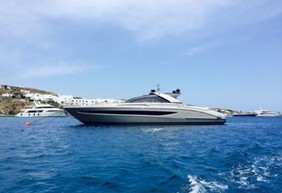
The brokerage power yacht market in 2025 proved to be far more resilient and dynamic than many industry observers expected. Against a backdrop of economic uncertainty, tariffs on new boats, and lingering inventory challenges, well-positioned brokerage firms continued to see strong demand, particularly for quality, well-maintained yachts in the mid-size power segment (30’-70’ LOA boats).
To better understand what really happened in 2025 and what lies ahead, I spoke with Ryan Miller and Matt Leduc, co-partners of Latitude Yacht Brokerage in Newport, Rhode Island. Latitude specializes in brokerage power yachts, primarily diesel-powered vessels in the 30- to 70-foot range and a variety of styles. Of course, their brokerage inventory and business includes sailboats as well. Their insights from a combined 45 years in the yacht brokerage business offer a grounded, real-world look at how buyers and sellers behaved in 2025 and how expectations are evolving as the market moves into 2026. This post focuses on power yachts and summarizes our discussion.
2025: A Growth Year Driven by Brokerage Demand
From Latitude Yacht Brokerage’s perspective, 2025 was clearly a growth year. The firm reported a 16.5 percent increase in brokerage power yacht sales compared to 2024, a notable result given broader economic headwinds last year. This growth was all brokerage boats.
One of the primary drivers for this was the impact of tariffs on new boats. As the cost of importing new vessels rose, many buyers chose to avoid paying a premium and instead focused on boats already imported and available on the brokerage market. For buyers, brokerage yachts represented more immediate availability, fewer unknowns, and often significantly better value.
Brokerage boat inventory: Quality Matters More Than Quantity
The downside of this was increased pressure on brokerage inventory, particularly for clean, well-maintained boats that were realistically priced. Clean, well-maintained boats that are ready to be used tend to sell in almost any market. There are plenty of boats on the market, but unfortunately many require more work than their asking prices justify.
Days on Market and the Reality of Seasonality
One common misconception among sellers is applying real-estate logic to yacht sales. Days on market for yachts, particularly in the Northeast, are heavily influenced by seasonality.
The prime buying window in the Northeast US runs roughly from April through July, and there’s usually a second spike in September-October. Boats listed outside that window may still sell, but the frequency of buyer activity drops significantly. Missing that peak season can dramatically extend days on market, even for well-priced boats.
This seasonality underscores the importance of timing when listing a yacht for sale, especially for sellers hoping to achieve a quick transaction.
That said, Latitude does move boats during the winter months. December 2025 was their busiest December in recent years, and January looks like it will be super busy as well.
Advice for Sellers of Older Power Yachts
For owners of older boats, preparation is everything. One of the strongest recommendations from Latitude is to invest in a pre-sale survey. (much of this advice is also applicable for newer models as well)
While buyers will always conduct their own surveys, a pre-sale survey allows sellers to identify and address potential issues before they surface during negotiations. This proactive approach can prevent unpleasant surprises late in the deal and help remove obstacles to closing.
Many sellers believe they have maintained their boats exceptionally well, and often they have. However, issues that only appear under survey conditions are frequently missed. Examples include moisture intrusion around deck hardware or cooling system components such as heat exchangers and after-coolers that have exceeded recommended service intervals.
Deferred maintenance is not always obvious during casual operation. Engines that are lightly used may never reach conditions that expose underlying issues, but a surveyor running the boat hard will often uncover problems that buyers cannot ignore. For example, during sea trial they will run the boat at much higher RPMs than their owners will during cruising, and if there are engine cooling issues they will become obvious here.
Maintenance Records and Transparency
Maintenance records continue to play a critical role in buyer confidence, particularly as yacht values increase. Major engine service intervals, often at 1,000 hours or based on time rather than usage, are increasingly scrutinized by buyers. Boats lacking documentation for these services often face price adjustments or repair requests during negotiations. We see many potential buyers walk away from boats before even seeing them if there are not good, documented service records available.
Many owners handle routine maintenance themselves, often recording only oil and filter changes (if you do your own maintenance PLEASE document that). This is not necessarily a negative, but transparency is essential. Buyers must weigh the cost savings of owner maintenance against perceived risk.
Advice for Buyers considering Older Brokerage Yachts
For buyers considering yachts from the 2010 era or earlier, realistic expectations are critical. Latitude advises buyers to view multiple boats to understand market norms and variations in condition and value.
No used boat is perfect. Buyers should budget an additional amount of capital, (say 5-10% of the purchase price) for post-purchase upgrades and maintenance, even on boats that appear turnkey. These costs are part of bringing a boat onto a new owner’s maintenance schedule and comfort standard. Remember, a boat built in 2010 and used in the Northeast has spent 15+ years in a saltwater environment. Even if well cared for that boat will very likely need some upgrades.
Structural integrity and major systems should always take priority over cosmetic concerns. Dirt, clutter, and outdated soft goods are far easier and cheaper to address than structural or mechanical deficiencies.
All this said, there are some great diamonds out there in the older boat market. Latitude can help you find them.
Looking Ahead to 2026
The outlook for 2026 is optimistic. Latitude Yacht Brokerage reported an exceptionally strong 2025, fueling confidence in continued demand.
For newer boats but also older boats with recent upgrades, emerging technology trends include greater system integration, gyro-stabilization, increased automation, lithium battery upgrades, solar installations, and even electric propulsion. While many of these technologies originate in new builds, retrofits are becoming increasingly common.
As systems become more complex, the role of specialized surveyors is growing. Buyers considering boats with pods, lithium systems, or advanced electrical setups must ensure their surveyors have the appropriate expertise.
Final Thoughts
The brokerage power yacht market entering 2026 remains strong but will be increasingly nuanced. Buyers and sellers alike must approach transactions with realism, transparency, and informed expectations. This is where your broker can help.
Please reach out and connect with us if you want to learn more. We will have brokers at both the Miami International Boat Show, as well as the Palm Beach Boat Show in the next couple of months and we’ll be walking the show floor as well as looking at brokerage boats in the area.
Good boats still sell. Deferred maintenance still matters. And there is no such thing as a perfect used yacht, only a well-chosen one.